Practice LLM serving, lightweight adaptation, containerization and observability through a production-style reference project. 1. Who can join Suitable for: ML engineers, AI developers and backend/platform engineers Mandatory prerequisites: Python, ML training fundamentals, Linux command line and Docker basics 2. Duration 60 live hours • Approximately 10 weeks at 6 hours per week; actual timetable to be confirmed. 3. Mode Classroom - Thaiyur / Kelambakkam, OMR Chennai (subject to schedule) Live Online (subject to schedule) 4. Syllabus — five modules
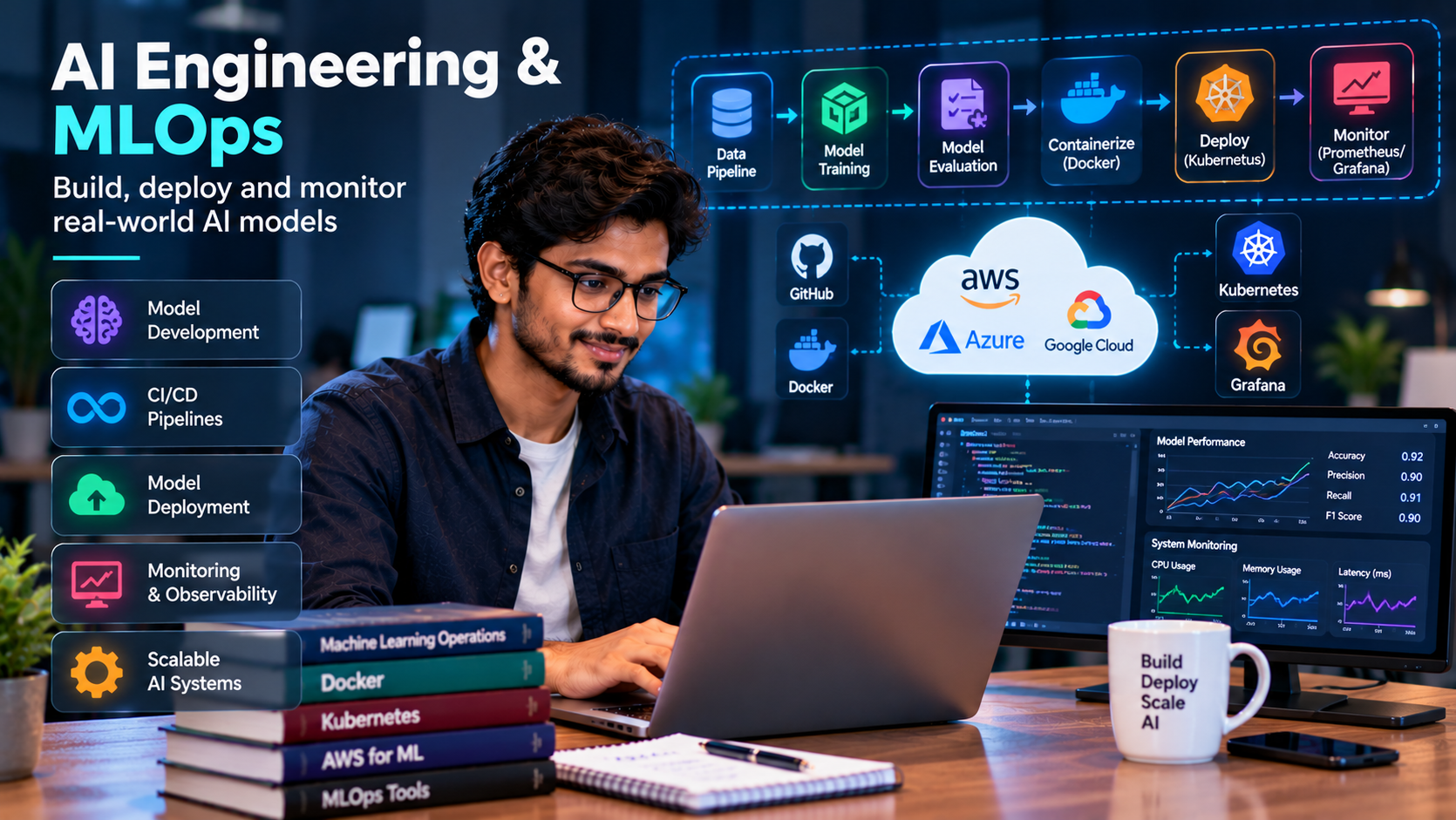
Module 1: Local LLM Execution & Optimization (Ollama, vLLM, GGML/GGUF Quantization) Learning outcome: Run local or server-hosted LLM inference and compare resource trade-offs. Module 2: Fine-Tuning Open-Source Models (Llama 3, Mistral) using PEFT/LoRA Learning outcome: Experiment with parameter-efficient adaptation on a small dataset. Module 3: CI/CD for Machine Learning Pipelines & Containerization with Docker Learning outcome: Package a model service and add automated checks. Module 4: Scalable Infrastructure with Kubernetes & Model Serving API Endpoints Learning outcome: Explain deployment scaling and demonstrate an API on suitable infrastructure. Module 5: Production Monitoring: Model Drift, Latency, Token Cost & Logging Learning outcome: Track latency, errors, evaluation scores and usage costs. 5. Practical project Source capstone title: Build & Deploy an End-to-End Fine-Tuned Llama 3 API Infrastructure Student deliverable: A versioned LLM API prototype with model configuration, container setup, test pipeline and a basic latency/token-cost monitoring dashboard.
6. What is included Live trainer-led sessions Practical assignments Sample code or templates, as applicable Project feedback Learning assessment Perizona course-completion certificate subject to assessment 7. Upcoming batch Start date: To be announced. Students can register interest; dates are shared only after confirmation.